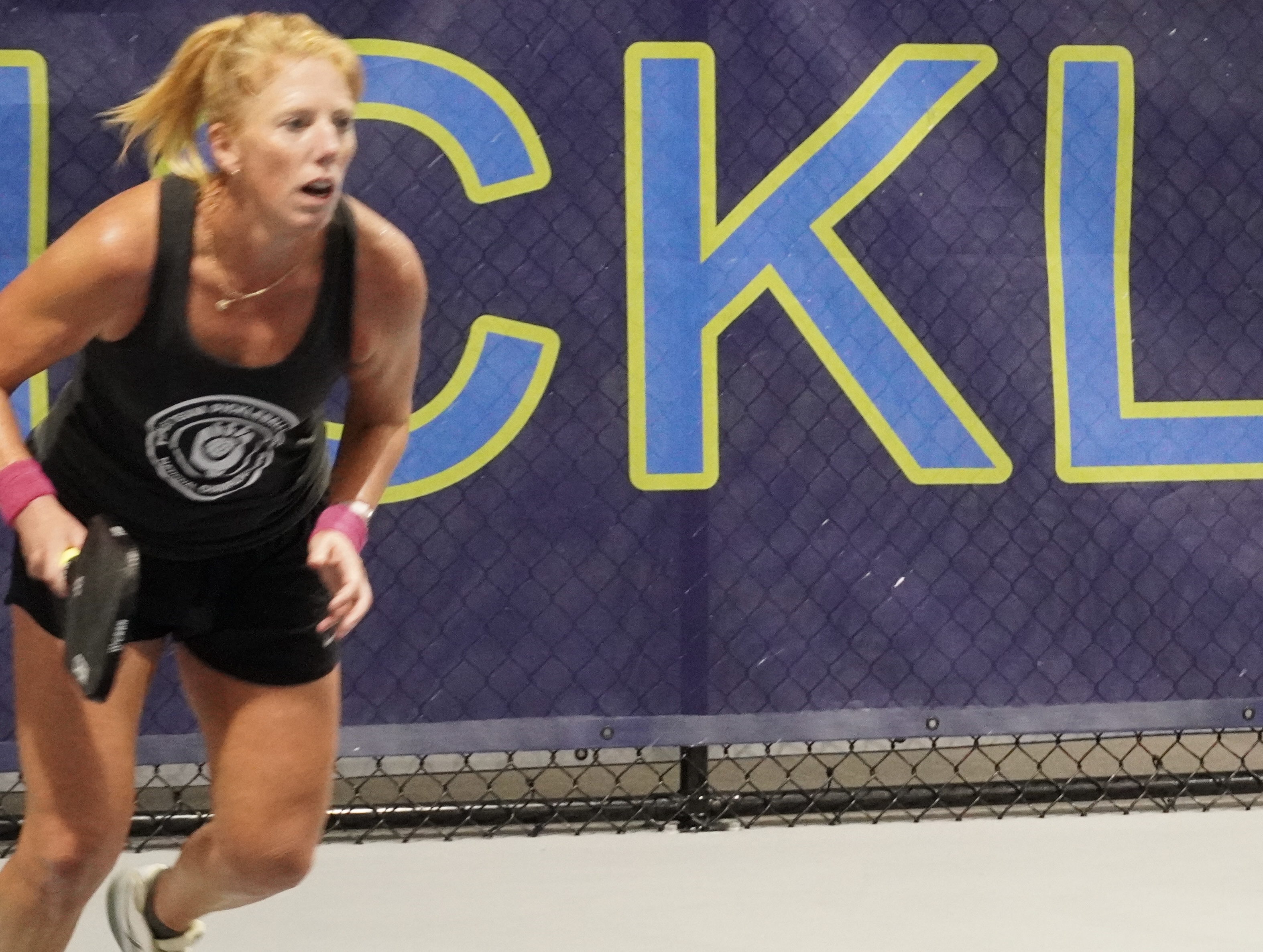
I care about winning. Just not until the match is over.
My coach asked me to recall a match where being too focused on the outcome wrecked my game.
I sat with it for a while. I couldn't find one.
This isn't because I don't care about winning. I care a lot. I play pickleball five times a week at the 4.0+ level, and I'm not out there for the cardio. I want to win.
I just stopped caring about winning during the match. That part belongs to after.
Process goals vs. outcome goals — and what most lists are missing
If you've read anything about sports psychology, you've heard the split. Outcome goals are results: win the match, hit 4.0, place in the bracket. Process goals are the behaviors underneath the result: land the third-shot drop, stay off the baseline, attack the middle. Most coaching conversations tell you to set two or three process goals for each session. Good advice. Not enough.
Here's what's usually missing: one of those process goals should be about your mind, not your game.
A tactical process goal says here's what I'm doing with the paddle. A mindset goal says here's what I'm doing with my attention, my self-talk, and my nervous system. Both are within your control. Only one of them determines whether the other one survives the third game of a tight match.
You can decide you're going to drive every third shot — and you'll do it beautifully for two games, until you miss a serve, then another, and suddenly you're standing at the baseline re-gripping your paddle, telling yourself you don't belong in this game, hitting the next drop into the net because your hands are now the cleanup crew for a mess your head just made.
The mindset goal is the one that protects the other goals. It's the meta-process goal. That's the argument of this whole post.
What is a mindset goal in pickleball?
A mindset goal is a specific, behaviorally concrete commitment about how you'll manage your head and body during play. Not "stay positive." Not "have fun." Those are wishes. A real mindset goal is something you can either do or not do on any given point.
The test: could a partner watching you play tell whether you did it or didn't? If yes, it's a mindset goal. If no, it's a mood.
Specifically, a mindset goal targets one of five things your mind does under pressure: recovery, self-talk, composure, attention (accountability), or boundary. More on each in a minute.
Why mindset goals protect everything else
During the match, the only thing I actually control is where my attention is. Am I in my body, or am I in my head? That's the whole question. The score is a result. The outcome is a result. Both will happen whether I think about them or not, and thinking about them mid-point doesn't make them happen faster — it makes them happen worse.
What "in my head" looks like for me
In my head is wondering what my partner is thinking about me. In my head is telling myself I don't belong in this game. In my head is missing a serve, then missing the next one, then missing the next one, and somewhere in there the little voice starts saying you are the worst player on this court — which, and I cannot stress this enough, is not a helpful input while you are trying to reset and serve again. In my head is a spiral. And spirals are expensive.
What "in my body" feels like
In my body is a felt sense of confidence in my chest. It's being honest with myself that maybe I don't belong in this game — and standing tall anyway, because I'm going to make sure people know I do. It's seeing the ball. Reading my partner. Moving. It's quiet, actually. Almost boring, in the best possible way. You cannot think your way into in-your-body. You can only drop into it. And the mindset goal is the door.
The five types of pickleball mindset goals
Here are mine, in the language I actually use on the court. One from each type. Pick whichever one meets the pattern you've been running lately.
1. Reset after every point — Recovery
Good or ugly, it's over. The next point doesn't care what just happened. The reset is the ritual that makes the clean start possible — usually a walk back to the baseline, a paddle tap, a breath. (More on this in The Reset Ritual.)
2. Steam out the ears — Self-talk
When a negative thought shows up — you're the worst one here, you're going to lose this for everyone — I picture it leaving my head as steam. I don't argue with it. I don't analyze it. I vent it.
3. Keep my cool when I miss — Composure
Translation: don't cuss loudly. Don't slam the paddle. Don't let the miss become a show. I am not proud of how much practice I needed on this one.
4. Own my mistakes — Attention
Out loud. "That was mine." There's nothing left to spiral about once you've already said it. Ownership is the fastest way to close the loop — it empties the room the rumination was about to move into.
5. Keep my partner on their side of the court — Boundary
Whatever they're thinking about me — that's their business, not mine. I have enough to manage on my side of the net. I can only play my game if I'm not also running a simulation of theirs. (Related: Your Partner Can Feel Your Bad Day.)
How to set your own pickleball mindset goal
Don't pick randomly. Pick the one that meets the pattern you've been running.
If you've been spiraling after errors — pick a recovery goal. If your self-talk has been brutal lately — pick a self-talk goal. If you've been slamming the paddle or cussing under your breath — pick a composure goal. If you've been carrying mistakes instead of owning them — pick an attention goal. If you've been reading your partner's face for the last three matches — pick a boundary goal.
Two more rules of thumb. Keep it concrete enough that you'd know if you did it. And grade yourself on whether you noticed when you drifted — not on whether you did it perfectly. Noticing is the actual skill. The cue is just the thing that trains the noticing.
The quiet truth about mindset work
You're not practicing this to win more (although you probably will). You're practicing it so that when you walk off the court, you don't owe yourself an apology.
Here's the thing I don't usually say out loud.
I'm not really playing pickleball to win. I'm not even playing for the cardio. I'm playing to get my head to shut up.
That's the real reason I'm out there five days a week. The silence. The stretch of time where the voice that narrates and judges and predicts and second-guesses doesn't get a vote. My body moves, the ball comes, I'm responding instead of thinking, and for an hour and a half the commentary is off.
And the quieter my head gets on the court, the quieter it stays off the court. But that's another post.
One last thing
Pick one mindset goal for your next match. Try it for a week. See what changes.
You'll probably win more. But that's not why you're doing it. You're doing it because the during is where your life is actually happening — and spending it in your head is a waste of a Tuesday.