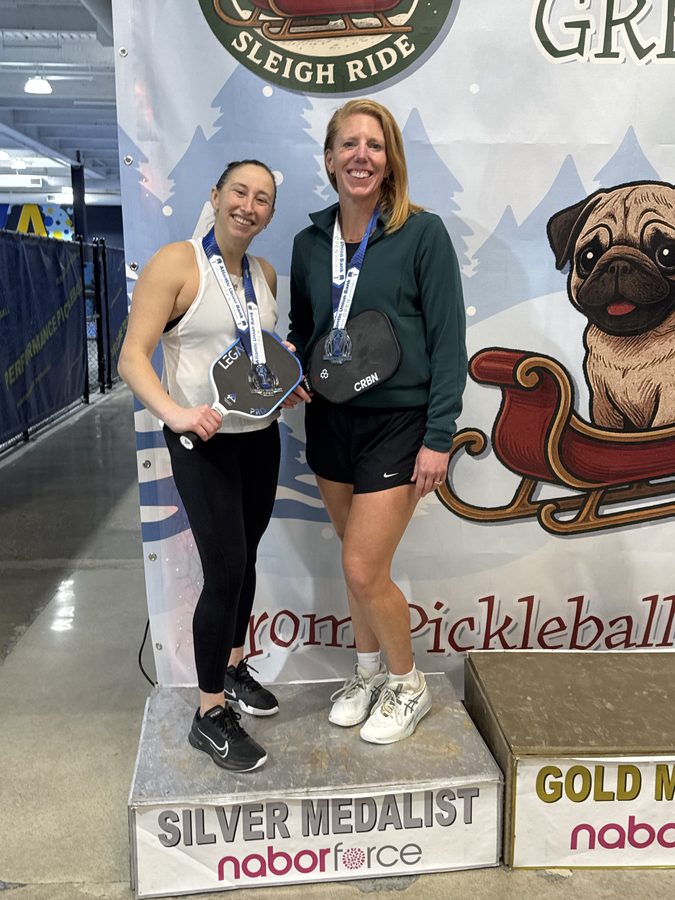
If I got a flat tire on the side of the road at 10pm, I know exactly who I'd call. Not because they're the most practical choice. Not because they live the closest. But because somewhere between the hard matches and the bad points and the moments where we had to figure out how to come back together — I learned that they show up.
My pickleball partners.
That probably sounds strange if you've never experienced it. It sounds completely obvious if you have.
There's a reason pickleball partnerships feel like more than just a game. It's not chemistry in the vague, unquantifiable sense. It's actual chemistry — the kind your body produces in real time, on every point, whether you're aware of it or not. The trust you build on the court is real. The bond is real. And once you understand the science behind why, you'll never think about your partnership the same way again.
Here's what's actually going on.
You are co-regulating, whether you signed up for it or not
Co-regulation is the term researchers use for what happens when two nervous systems shape each other in real time. Your heart rate, your breathing, your stress hormones, your micro-expressions — they're all being read by the person next to you, and theirs are being read by you. Constantly. Without permission.
This is not a metaphor. It's measurable. Studies of rowing crews, surgical teams, parent-infant dyads, and married couples have all shown the same thing: when two people are in close coordination, their physiological states sync up. They breathe together. Their cortisol rises and falls in parallel. Their heart rate variability tracks each other.
Your doubles partner is doing this with you every single point. So when they're tight, your body feels it before your mind names it. When they're calm, your body borrows their calm. (For more on this in action, see Your Partner Can Feel Your Bad Day.) The court is not just a place where two people play a sport. It's a shared nervous system operating in public.
Your partnership dynamic is always active
Research on how humans perform under pressure turns out to describe a lot of what happens on a pickleball court.
Here's the basic idea. When we feel connected to a teammate and the situation is high-stakes, our nervous system starts tracking: Is this person with me? Will they stay if I fail? Are they going to be there when I need them? These are not conscious questions. They're nervous-system-level questions, and they get answered through tone of voice, body language, eye contact, and what happens after a missed ball.
This is why a partner's sigh after your error can feel disproportionate to what actually happened. Your nervous system isn't responding to the sigh. It's responding to the question are you still with me? — and reading the answer as no.
I saw this play out recently in a match against a close friend — someone I laugh and chat with between points almost every time we play. That day I was locked in. Quiet, focused, grinding in the best possible way. I was genuinely happy.
She interpreted it as me being upset with her.
My partner knew immediately that I wasn't. He'd played enough points with me to read my focused quiet as a good sign, not a threat. But from the outside — from someone whose nervous system was tracking me without the context of our partnership — the signal read as withdrawal. As distance. As something wrong.
That's the partnership dynamic at work. The same behavior lands completely differently depending on whether the person reading it knows your baseline. A secure, established partner builds a kind of fluency with you — they learn your tells, your patterns, your version of locked in versus shut down. That fluency is not incidental to your performance. It's central to it.
The chemicals are real
When you step on the court for a tournament point, your body releases adrenaline and cortisol — the same stress chemicals that flood your system in any high-stakes situation. Your heart rate climbs. Your peripheral vision narrows. Your fine motor control degrades.
But here's the part that matters for partnerships. When you regulate that stress with your doubles partner — when you make eye contact, tap paddles, breathe together, exchange a steady word — your body releases oxytocin, the bonding chemical associated with trust and team cohesion. The same one released between elite teammates, between surgeons and their teams, between anyone who goes through something hard together and comes out the other side.
The opposite is also true. When you go through a high-stakes moment and your partner isn't there with you — when they're frustrated, distant, checked out — your body registers it as I went through that alone. That registers as a threat. And the next time you step on the court with them, your nervous system remembers.
This is why doubles partnerships build trust faster than almost any other recreational relationship — and why they break down faster too. The chemistry is doing more work than you realize.
The dyad is the most exposed unit in sport
Most relational structures have built-in buffers. Teams have benches. Families have multiple members. Workplaces have HR. The doubles dyad has none of that. Two people, no diffusion, no escape hatch, sharing every point in real time.
That's why the partnership feels charged. It's not because you're too sensitive or your partner is too much. It's because the structure itself has no shock absorbers. Whatever happens between you happens at full intensity, with no third party to soften it.
And here's what pickleball communities do naturally in response to that intensity — they create an informal third party. When something goes wrong in a partnership, the easiest relief valve is to talk to someone else about it. Another player at the courts. A mutual friend. Someone who was watching. It feels like processing. It feels like getting perspective.
But in a tight pickleball community, that third party is almost never neutral. They know both of you. They play with both of you. And what starts as venting quietly becomes a narrative that travels — shaping how others see your partner, how your partner eventually hears it back, and how the community positions itself around a conflict that was never theirs to hold.
The drama that surfaces in pickleball communities almost always traces back to a dyad that had no shock absorbers and looked for one in the wrong place. The solution isn't to bottle it up. It's to build a partnership where you can say the hard thing directly — to each other — before it needs a third party at all.
This is also what makes great partnerships so powerful
The same exposure that makes a bad partnership painful is what makes a good partnership transformative. There's nowhere to hide — and that means there's nowhere your partner's belief in you can hide either.
When it's there, you feel it in a way that is hard to describe and impossible to fake. It's the partner who looks at you after your worst point of the match and says nothing — because their face already said I've got you. It's the one who calls your ball out when everyone else would have let it go, because they trust you can handle the truth. It's the steadiness you borrow when your own is gone.
That belief does something physiological. It lowers your cortisol. It steadies your heart rate. It widens your peripheral vision back out. You stand a little taller, swing a little freer, take the shot you've been second-guessing. Not because you got better in that moment — but because someone's belief created the conditions for your best game to show up.
The research on high-performing teams confirms what players already know in their bodies: you perform differently when someone genuinely believes in you. Not the performed encouragement of a partner who's managing you. The real thing. The kind that doesn't waver after a double fault or a blown put-away.
When you have that, you know it. And when you don't, you feel that too — in every tight moment, every hesitation, every shot you didn't go for because some part of you wasn't sure they'd still be there if it didn't land.
What to do with this — and how to win with it
Notice that none of this is a flaw. It's not something to fix. The intensity isn't a sign that you're bad at doubles or that your partnership is broken. It's a sign that you're human, you're playing with another human, and your body is responding the way human bodies respond.
The goal isn't to lower the intensity. The goal is to weaponize it.
Because here's what the best doubles teams understand that most players don't: the same system that makes a bad partnership painful makes a great partnership a genuine competitive advantage.
When your nervous systems are linked and both of you know how to use that link deliberately, you stop being two players sharing a court. You become something harder to beat. You're reading each other faster than the other team can read either of you. You're regulating each other in real time — which means when one of you wobbles, the other steadies, and the wobble never becomes a spiral. You're broadcasting calm into each other's nervous systems between points while your opponents are broadcasting anxiety into theirs.
That's not a small edge. That's a structural advantage.
The practical version looks like this: you learn your partner's baseline so well that you know the difference between their focused quiet and their shut-down quiet — and you respond to each one differently. You develop a reset ritual together so that the 10 seconds after a hard point are never wasted on disconnection. You practice the small signals — the eye contact, the paddle tap, the one word that means we're okay — until they're automatic under pressure.
You stop managing your partner and start trusting them. You stop performing encouragement and start meaning it. You build enough relational fluency that your partner's nervous system can borrow yours on the points where theirs runs out.
And then you walk on the court against a team that hasn't done any of this work. Two talented individuals sharing a court, each managing their own mental game in isolation, neither one quite sure if the other is really there.
You already know what happens next.
The mental game in doubles isn't individual. It never was. The players who understand that — and build their partnerships accordingly — don't just feel better on the court. They win more. Not because they got more talented. Because they figured out how to make the system work for them instead of against them.
That's the work. And it starts the moment you decide that your partnership is worth taking as seriously as your backhand.